New Homeowner Lock Checklist: What to Change After Moving In
Moving into a new home is exciting, but the locks should be one of the first things you think about. Why? Because you simply do not know how many keys are out there and your new home should start with keys you control.
This new homeowner lock checklist walks through what to change, what to test, and what to ask a locksmith after moving in.
Table of Contents:
- Rekey the Exterior Door Locks
- Decide Which Locks Should Be Replaced
- Check Every Entry Point
- Test the Deadbolts
- Look at the Garage Door Access
- Update Smart Locks and Keypads
- Check Sliding Doors and Patio Locks
- Make a Spare Key Plan
- Know When to Call a Residential Locksmith
- Final New Homeowner Lock Checklist
Rekey the Exterior Door Locks
The first lock task after moving in is usually rekeying.
Rekeying changes the inside pins of the lock so the old key no longer works. You keep the existing hardware, but you get a new key. For many new homeowners, this is the most practical first step because the lock itself may still be in good shape.
You should rekey any exterior door that uses a key, including:
- Front door
- Back door
- Side entry door
- Garage entry door
- Guest house or detached office door
- Storage room or exterior utility door
If one old key opens multiple doors, your locksmith may be able to rekey those locks to work with one new key again, which keeps things simple without leaving the old key active.
For Tampa Bay homeowners, this is also a good time to ask about same-day home rekeying. You do not need to wait until there is a problem. It is one of those small moving-in tasks that makes the house feel fully yours.
Decide Which Locks Should Be Replaced
Rekeying is not always enough.
Some locks are worn down, loose, rusted, outdated, or damaged from years of use. Florida weather can be rough on exterior hardware, especially if the door gets a lot of humidity, rain, or salt air.
Replace the lock if you notice:
- The key sticks or catches
- The deadbolt does not line up cleanly
- The lock wiggles in the door
- There are signs of forced entry
- The finish is badly corroded
- The hardware feels cheap or flimsy
- The lock has been painted over
- The door does not latch unless you pull or lift it
A lock should feel smooth and solid. If you have to fight with it every time you leave the house, it is not just annoying, but it also might not be securing the door properly.
New hardware also makes sense if you want all exterior doors to match, want a different finish, or want to upgrade to a stronger deadbolt.
Check Every Entry Point
New homeowners usually check the front door first. That makes sense, but it is not the only place that matters. Walk the property and look at every way someone could enter the home. This includes doors you may not use every day.
Check:
- Front door
- Back door
- Side doors
- Garage service door
- Door from garage into the house
- Patio doors
- Balcony doors
- Detached garage
- Shed
- Pool house
- Side gate locks
Look for locks that do not latch, doors that sit unevenly, missing strike plate screws, weak knobs, and doors that can be pushed open even when locked.
This is also a good time to label which key goes where. If you are standing in your kitchen with a pile of mystery keys from the seller, this could be a sign to simplify the setup.
A locksmith can look at the full property and tell you which locks can be rekeyed, which should be replaced, and which entry points need better hardware.
Test the Deadbolts
A deadbolt is only useful if it works correctly. Close each exterior door and lock the deadbolt from the inside. The bolt should slide fully into the strike plate without forcing it. If you have to push, pull, lift, or slam the door to get the lock to work, something is definitely misaligned.
It could mean the door has shifted, the strike plate is off, or the lock was not installed properly. This does not mean every new homeowner needs heavy-duty hardware on every door, but it does mean the main entry doors should have properly installed deadbolts that line up.
Look at the Garage Door Access
Garages are easy to overlook during a move.
The garage may still have old remotes, keypad codes, side-door locks, or interior access points that were never updated.
Start with the door between the garage and the house. If it has a keyed lock, rekey it. If it only has a basic knob, consider adding a stronger lock.
Then check the garage opener system. Reset remotes and keypad codes if possible. Keep in mind that if the seller handed you one garage remote, that does not mean it is the only one.
Detached garages and storage areas should be checked too. Tools, bikes, lawn equipment, and holiday storage are easy targets when those locks are weak.
Update Smart Locks and Keypads
If your new home has a smart lock, keypad, or electronic deadbolt, do not assume the old codes were removed.
Reset the device and create new access codes. Delete any previous users. Change the connected app login if it was transferred to you. If you cannot access the admin settings, replace or professionally reset the lock.
Smart locks are convenient, but only when you control the settings. A code from the last owner should not still open your front door.
If you want a smart lock installed, ask a residential locksmith which type makes sense for your door. Not every smart lock fits every setup cleanly.
Check Sliding Doors and Patio Locks
Sliding doors are common in Florida homes, and they deserve more attention than they usually get. Many sliding door locks are basic. Some are worn out and do not fully catch. Others look locked but can still be forced open with pressure.
After moving in, check every sliding door and patio door. Lock it, then gently test the door from the inside. It should not shift open. Look at the track, latch, handle, and secondary security bar if there is one.
If the lock feels weak, replace it. If the door does not sit correctly in the frame, get that looked at too. This is especially important for homes with back patios, pools, fenced yards, or side areas that are not easily visible from the street.
Make a Spare Key Plan
Once your locks are rekeyed or replaced, think carefully about spare keys. You do want backup access, but you don’t want random keys floating around with no plan.
A good spare key plan is simple:
- Give a spare to one person you fully trust
- Avoid hiding keys under mats or flowerpots
- Do not label keys with your address
- Keep track of who has a copy
- Change access if a key goes missing
If you use a keypad or smart lock, create separate codes instead of giving everyone the same one. That way, you can remove a code without changing access for the whole household.
Whatever you choose, a clear key plan prevents problems later.
Know When to Call a Residential Locksmith
Call a locksmith if you just moved in and any of these apply:
- You do not know who has old keys
- The locks are difficult to use
- You want all doors on one key
- A deadbolt does not line up
- You have a broken key or stuck key
- You want smart locks installed
- You need same-day rekeying
- You want a home lock check after closing
A mobile residential locksmith can come to the home, inspect the locks, rekey what still works, and replace what does not. That is usually easier than trying to figure out each door one at a time on your own.
Quick Note About Choosing a Locksmith: Before calling a locksmith, make sure the company is local, clearly lists its phone number, and gives straightforward pricing. The FTC also recommends being cautious with locksmith listings that use vague business names, quote unusually low prices, or send someone who arrives in an unmarked vehicle.
For homeowners in Tampa, St. Petersburg, Clearwater, Brandon, Riverview, Wesley Chapel, and surrounding Tampa Bay areas, Oncall Locksmith handles residential lock rekeying, lock replacement, smart lock installation, broken key extraction, and home security upgrades.
Final New Homeowner Lock Checklist

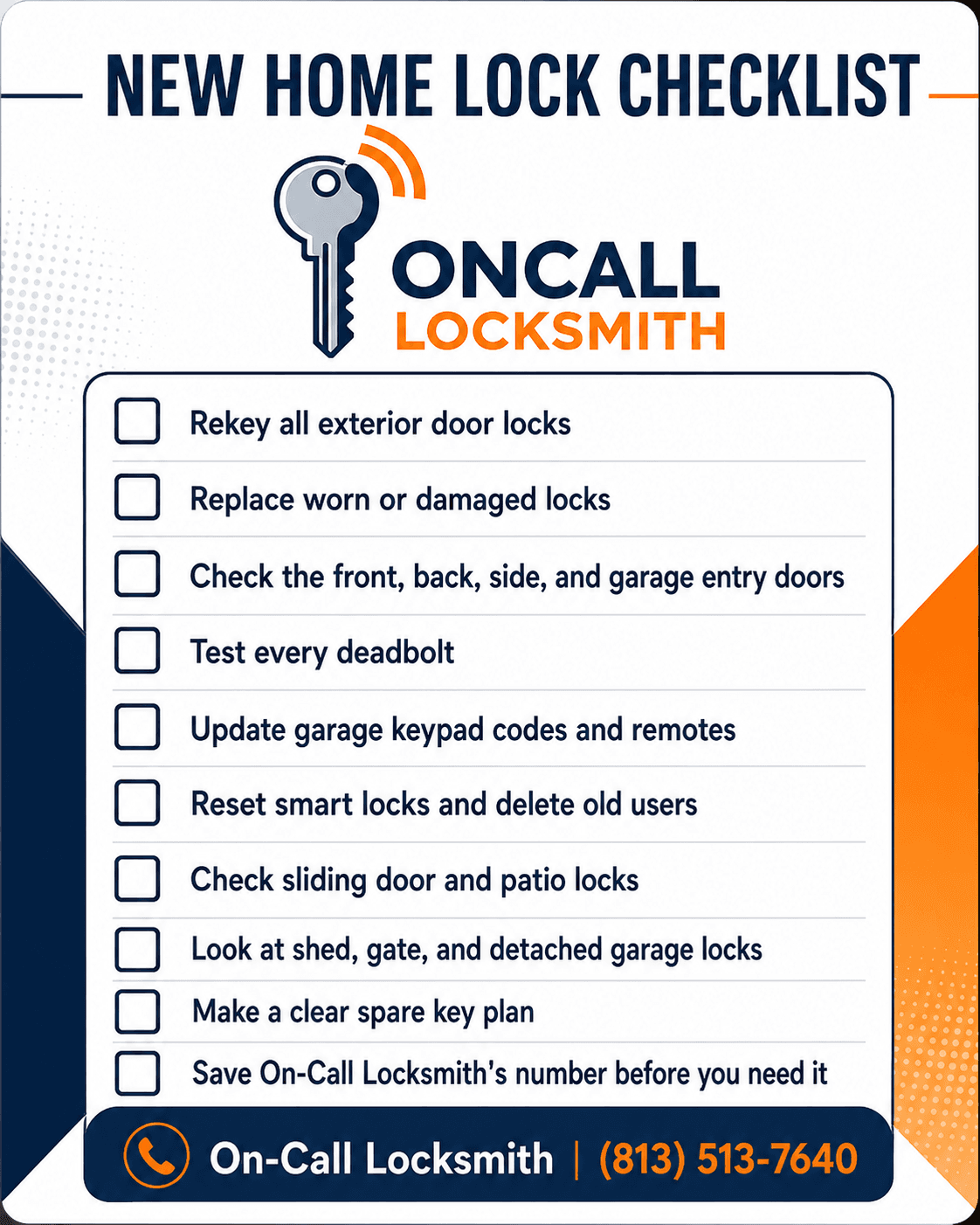
Use this quick checklist after moving in:
- Rekey all exterior door locks
- Replace worn or damaged locks
- Check the front, back, side, and garage entry doors
- Test every deadbolt
- Update garage keypad codes and remotes
- Reset smart locks and delete old users
- Check sliding door and patio locks
- Look at shed, gate, and detached garage locks
- Make a clear spare key plan
- Save Oncall Locksmith’s number before you need it
A new home should not come with old access.
Before you get too settled, rekey the locks that are still in good shape, replace the ones that are not, and reset every code tied to the property. It is a small step, but it closes the gap between “we just moved in” and “this house is actually ours.”
Need your new home rekeyed in Tampa Bay? Call Oncall Locksmith at (813) 513-7640 for mobile residential locksmith service or visit our contact page for more options.